
Does Apple's Vision Pro headset change VR forever?
Author: Mukund Shyam
Published on: 11 06 2023
It’s tech season again! Today, we talk about one of the most looked-forward-to (and at the same time, most interesting) tech announcements of this year: Apple’s take on the virtual reality headset, called the Apple Vision Pro.
Sitting at an absolutely ludicrous $3499, it’s definitely not a product for the masses. It’s a product meant to spark interest in a new category that Apple will perhaps invest more into in the future, perhaps even making a cheaper headset.
Apple has always been extremely influential in the tech world; whatever they do, almost every other company follows. The question is, can Apple do the same in the market of VR headsets, a market that’s infamously bland at the moment?
I think it may be possible, due to a combination of massive technological leaps as well as Apple’s industry clout, and their ability to attract developers onto a new platform (see also: Apple’s switch to their own in-house, M-series ARM-based processors for the Mac).
But first, let’s talk about the headset.
The Technical Bits
Apple’s Vision Pro headset was announced just this Monday, at WWDC 2023. Unlike other Apple products, though (maybe because Apple wants developers to make apps for the headset before they actually launch it), it’ll only launch some time next year, accompanied with the eye-watering price of $3,499 US.
Of course, given that it’s an Apple product, the considerably light wallet will be accompanied by a considerably heavy product. Apple’s headset, unlike most other VR headsets (like Meta’s Quest series), is made almost completely of metal and glass; and expecting Mac-level build may not be too unfounded (especially given Apple’s industrial design expertise, and the steep price).
The headset’s design isn’t too far a departure from the design of current-gen VR headsets like the Meta Quest 3 and the HTC Vive, with a design that completely covers the eyes and with supports around the head. Apple’s headset (like other headsets, again) doesn’t have a built in battery (perhaps to reduce weight), but has a proprietary cable that connects to a battery bank that you put in your pocket (or something similar).
This battery gives the headset a battery life of 2 hours, which is… pretty bad. But I suppose it makes sense, given the kind of displays that are being driven.
The displays are among the most advanced parts of the Vision Pro. There are 3 displays on Apple’s headset: one in front of each eye, and one that faces outwards.
The ones in front of each eye are pretty incredible: 4K and micro-OLED, we can expect the clarity and contrast to be industry leading. The size of a pixel on this display is 1/60th of the size of an iPhone display pixel, so the stair-step effect will likely be extremely minimal.
There’s also an outward facing OLED, for some interesting (to say the least) software features (more on that later!).
Of course, considering it’s Apple, it has an arguably overkill processor: the M2 (for context, that’s the same processor present in the new MacBook Air and the Mac Mini). On top of that, it has a new chip called the R1, which serves to process inputs from all the cameras and sensors (more on that later). This allows the headset to have near-real-time latency: only 12 milliseconds!
The Software
Apple’s shtick is arguably their software - Apple’s software (most of the time) is quite polished, and often has extremely inventive features (at least, for new product lines). This carries forward with the Vision Pro.
The Vision Pro runs on a new operating system called visionOS (which seems to be an extension of iPadOS) and, as with all Apple products, already has support for most of Apple’s apps (like Safari and FaceTime). This makes the software experience already fairly compelling as a standalone computer.
On top of that, Apple has made some (honestly pretty slick) features that change the way AR/VR headsets are interacted with.
First of all, the Vision Pro has no controllers, unlike most other present-day VR headsets. The way you interact with the Vision Pro, then, is using eye tracking (!!) and hand gestures (!!!) which is absolutely insane. To select an app, you just look at it, and touch your hands together (basically the same as a click).
On top of that, the Digital Crown on the Vision Pro serves as a sort of knob for immersiveness. Turning it one direction reduces peripheral vision and increases the immersiveness of your content. Turning it in the other direction increases peripheral vision and turns it closer to an AR headset.
Apple has also incorporated an interesting feature using the wide array of cameras and sensors present on the Vision Pro: 3D recording. You can use the headset to record moments in 3D, and relieve them using the headset.
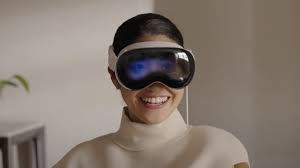
On top of that, the front OLED has an interesting use: if the “immersiveness level” (whatever Apple decides to call it) is low, the front OLED will show a real-time updating feed of the user’s eyes, using the internal eye-tracking cameras. On the other hand, if the “immersiveness level” is high, an animation plays on the cameras.
Does this change VR forever?
VR headsets have 3 main things that they can do (courtesy MKBHD): content, connections, and computing. Their use in all 3 of these fields are… dubious at best, and the Vision Pro doesn’t really change that.
First up, content. This is probably the field that the Vision Pro performs the best in… if you live alone. It has pretty insane displays as well as (apparently) pretty good cameras, and if the software catches up, the experience of using the Vision Pro as a portable TV would be pretty good.
Next, connections. Here, the critical factor is software: if the software for VisionOS FaceTime or Zoom is good, then this could be a very compelling use for the Vision Pro headset, especially in a business settings. Already, Apple’s ideas seem a lot more compelling and less weird than Meta’s: the realistic “persona” (as Apple calls it) is a lot better than whatever Meta’s avatar plan is.

Lastly, computing. This is the most unknown quantity of the Vision Pro: no one really knows what the experience is like using VisionOS. No one knows what is the kind of work that can be done on the Vision Pro headset. All this comes down to what apps get developed for/ported over to VisionOS. The advantage here is that Apple has the industry pull to convince developers to develop for this platform… but no one knows how it’ll turn out. We’ll have to wait and see.
To conclude, whether the Vision Pro changes VR forever depends on one thing and one thing only: developers.
We need to understand what problems the Vision Pro is trying to solve, and we can only figure that out by understanding what apps will come bundled with it. That will show what Apple (and other developers) want from the Vision Pro, and it’ll finally reveal whether the VR train will actually go somewhere, or if it’ll just burn out.
One thing is for sure, though: technologically, the Vision Pro is probably the most advanced headset we’ve seen yet. The innovations here are definitely going to trickle down to other headsets, especially the controller-less interactions.
The cost, though, means that this will definitely not be a mass-market product. Pity.
Thanks for reading!